
When visiting Todai-ji Temple, the first thing you should see is the Rushana Buddha, known as the “Great Buddha of Nara.”
🔹Rushana Buddha
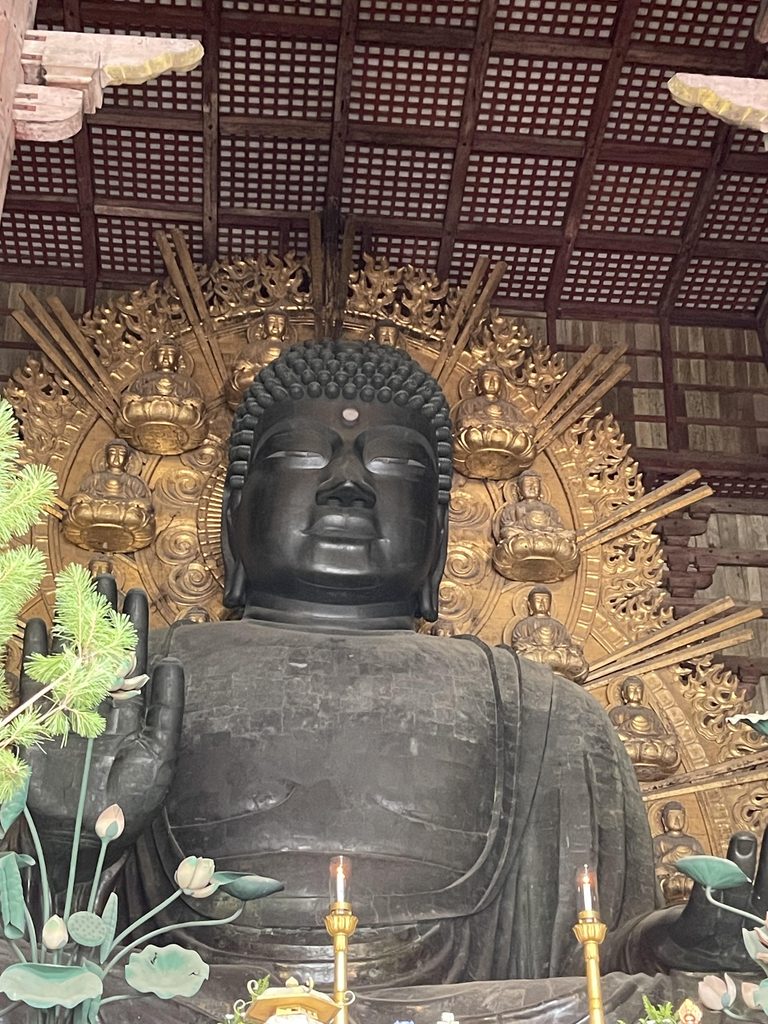
The Great Buddha of Todai-ji was not created merely as a large statue. It was commissioned during the Nara period by Emperor Shomu, who sought to ensure the peace and stability of the nation through the power of Buddhism.
At the present-day Todai-ji, visitors can view the Rushana Buddha (Vairocana) enshrined within the Great Buddha Hall.
While the sheer size and architecture of the Great Buddha Hall are impressive in their own right, the hall houses other Buddhist statues alongside the Rushana Buddha.
Therefore, when visiting Todai-ji, simply looking at the Great Buddha is not enough; learning the story behind its creation beforehand will allow you to appreciate the temple’s history on a much deeper level.
2.1 Why was the Great Buddha of Todai-ji built?
🔸The official name of the “Great Buddha of Nara” is Rushana Buddha
The statue commonly known as the “Great Buddha of Nara” is officially named Rushana Buddha.
At Todai-ji, this Rushana Buddha is revered as the temple’s principal object of worship.
Rushana Buddha is a significant figure in Buddhism, regarded as a Buddha who illuminates the vast universe.
Thus, rather than focusing solely on its physical characteristics as a “colossal statue,” it is important to understand the Great Buddha of Todai-ji as a figure created to symbolize the wish for the well-being and peace of the people.
🔸The background behind Emperor Shomu’s decision to build the Great Buddha
The creation of the Great Buddha at Todai-ji was deeply influenced by the social conditions of the Nara period.
At the time, the nation faced significant instability due to factors such as recurring epidemics and social unrest.
Amidst these circumstances, Emperor Shomu resolved to build the Great Buddha, hoping to secure the nation’s peace and stability through the power of Buddhism.
The eye-opening ceremony (consecration ritual) for the Great Buddha took place on April 9, 752 (the fourth year of the Tenpyo-Shoho era).
🔸Praying for the Nation’s Peace and Well-being through Buddhism
To understand the background behind Emperor Shomu’s decision to commission the Great Buddha, it is crucial to grasp the mindset of the era: the desire to ensure the nation’s peace and well-being through Buddhism.
Emperor Shomu did not merely commission the Great Buddha; he also implemented a policy to establish state-sponsored temples for monks (Kokubun-ji) and nuns (Kokubun-niji) across the country.
At the heart of this network stood Todai-ji Temple.
Todai-ji was not created simply to house a single large Buddha statue.
It was a temple that expanded significantly alongside the construction of the Great Buddha, reflecting the aspirations of the Nara-period people for social stability and general well-being.
🔸The Relationship Between the Great Buddha and Todai-ji
You might be wondering, “What exactly is the relationship between the Great Buddha and Todai-ji?”
To summarize briefly:
Emperor Shomu commissions the Great Buddha
↓
Construction of the Great Buddha proceeds
↓
Todai-ji develops as a temple centered around the Great Buddha
↓
The Great Buddha’s eye-opening ceremony takes place in 752
↓
It continues to be worshipped as Todai-ji’s principal image to this day
This is the sequence of events. In short, the Great Buddha is indispensable to understanding Todai-ji.
2.2 Highlights of the Great Buddha Hall
The Great Buddha Hall (Kondo, or Golden Hall) is the structure that houses Todai-ji Temple’s Great Buddha.
According to the official Todai-ji website, the current Great Buddha Hall is a reconstruction from the Edo period; its scale differs from that of the hall built at the temple’s founding or during the medieval period. Nevertheless, the current hall remains known as one of the world’s largest wooden structures.
Many visitors are overwhelmed by the sheer presence of this massive building even before stepping inside.
However, the building’s size is not its only highlight.
🔸Experiencing the Scale of the Great Buddha Hall
When visiting the Great Buddha Hall, start by viewing the entire structure from a slight distance.
Viewing it from the front allows you to fully appreciate the scale of its massive roof and expansive structure.
Part of the charm of visiting Todai-ji is the experience of walking from the Nandaimon (Great South Gate) through the Chumon (Middle Gate) toward the Great Buddha Hall, watching the building appear increasingly grand as you approach.
It is worth noting that the current hall is a reconstruction and is smaller than the original structure built at the temple’s inception. Even so, it remains immense—a landmark building that embodies the history of Todai-ji, which has endured since the Nara period.
🔸The Rushana Buddha Inside the Hall
Upon entering the Great Buddha Hall, the massive Rushana Buddha comes into view directly ahead.
First-time visitors are often immediately struck by its sheer size.
However, rather than focusing solely on its dimensions, try to reflect on why this statue was created here.
As mentioned earlier, the Great Buddha of Todai-ji has its roots in the Nara period, reflecting Emperor Shomu’s prayer for national peace and stability through Buddhism.
When you view the Rushana Buddha with this historical context in mind, you see it not merely as a colossal statue, but as a symbol of faith that has been passed down for nearly 1,300 years.
🔸Pay attention to the other Buddhist statues surrounding the Great Buddha
Inside the Great Buddha Hall, try not to focus solely on the central Rushana Buddha; take a moment to observe the other statues enshrined around it.
Statues of the Bodhisattvas Kokuzo (Akasagarbha) and Nyoirin Kannon (Cintamanicakra Avalokitesvara) are enshrined as attendants to the Rushana Buddha.
Additionally, statues of the guardian deities Komokuten (Virupaksha) and Tamonten (Vaisravana) are housed within the hall.
Rather than simply looking at the central Great Buddha and leaving, take your time to survey the interior; this allows you to appreciate the expressions, postures, and symbolic placement of each statue.
🔸The “pillar hole”: A must-see feature of the Great Buddha Hall
One of the most famous features of the Todai-ji Great Buddha Hall among tourists is the hole cut into one of the pillars.
It is often said that this hole—located in one of the hall’s pillars—is the same size as the Great Buddha’s nostril.
There is a legend that crawling through this hole brings blessings such as good health and freedom from illness; however, it is important to present this as folklore or popular belief rather than a guaranteed benefit endorsed by Todai-ji itself.
Also, please note that not everyone can fit through the hole; depending on crowd conditions or body size, passing through it may be difficult.
🔸Tips for viewing the Great Buddha at Todai-ji
If you are visiting Todai-ji for the first time, following this sequence will help you get the most out of your visit:
If you are visiting Todai-ji for the first time, following this sequence will help you get the most out of your visit:
① Head from the Nandaimon (Great South Gate) to the Great Buddha Hall
↓
② Admire the exterior of the Great Buddha Hall
↓
③ View the Rushana Buddha inside the hall
↓
④ Observe the surrounding Buddhist statues
↓
⑤ Look at the architecture of the hall and the pillars
↓
⑥ Offer your prayers while reflecting on the temple’s history, which dates back to the Nara period
By doing this, you can experience the history and Buddhist culture of Todai-ji, rather than simply snapping a photo of the Great Buddha and moving on.