
Beyond the Great Buddha Hall—famous for the Great Buddha of Nara—Todai-ji Temple offers many other highlights well worth seeing.
If you are visiting Todai-ji for the first time, the Nio (Guardian King) statues at the Nandaimon Gate, Nigatsu-do Hall, and Hokke-do Hall (Sangatsu-do Hall) are absolute must-sees.
🔹 Nigatsu-do Hall
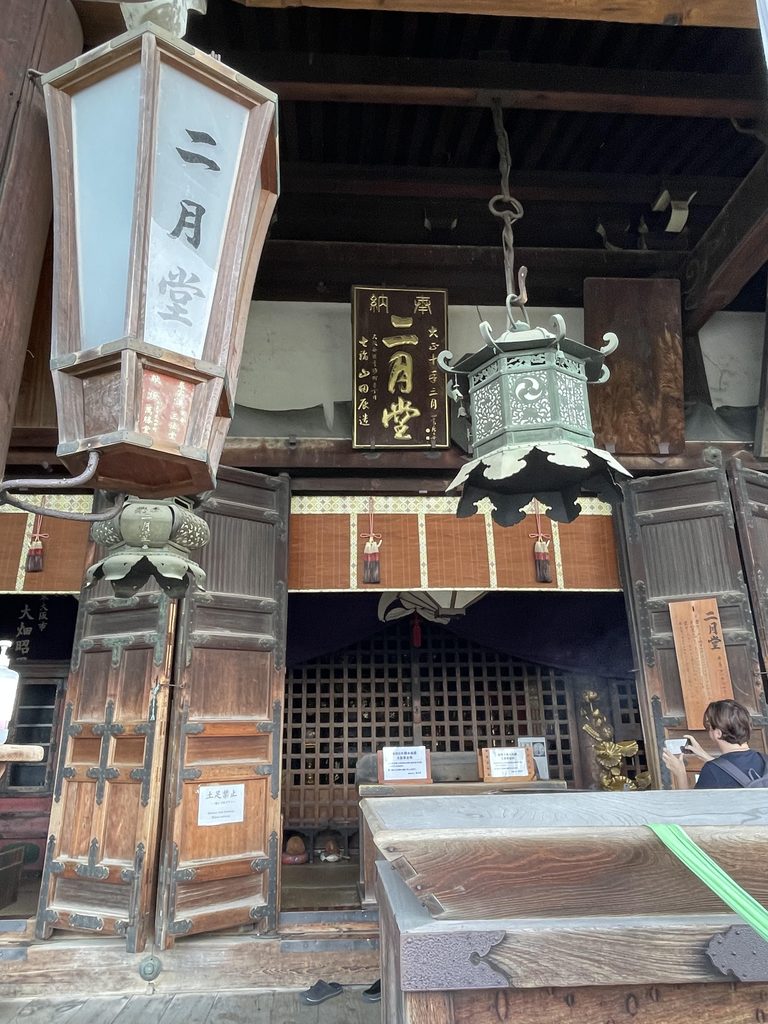
At the Nandaimon (Great South Gate), you can view the imposing statues of the Kongō Rikishi (Vajrapani) up close, while Nigatsu-dō offers a view of the temple grounds that differs from the perspective found at the Daibutsu-den (Great Buddha Hall). Meanwhile, the Hokke-dō houses a precious collection of Buddhist statues that convey the Buddhist culture of the Nara period to the present day.
Rather than limiting your visit to Todai-ji to just seeing the Great Buddha, it is highly recommended to stroll through the temple grounds and appreciate the architecture, Buddhist statues, and history.
3.1 Nandaimon and the Kongō Rikishi Statues: An Impressive Gate Symbolizing Todai-ji
The Nandaimon is one of the first large structures you encounter when visiting Todai-ji.
As the temple’s main gate, the current structure was rebuilt during the Kamakura period. Designated a National Treasure, it stands as one of Todai-ji’s most iconic historical buildings.
🔸Nandaimon: A National Treasure Rebuilt in the Kamakura Period
The current Nandaimon was reconstructed by the monk Chōgen, who played a pivotal role in the restoration of Todai-ji.
After the original gate—built during the Tenpyō era—collapsed during the Heian period, the gate was rebuilt in the Kamakura period. It features an architectural style known as Daibutsu-yō (Great Buddha Style), which incorporates architectural techniques from the Song Dynasty of China.
With its massive roof and thick pillars, the Nandaimon commands a powerful presence at the entrance to the approach leading to the Great Buddha Hall.
Passing through the Nandaimon, you will see the approach extending straight ahead toward the Great Buddha Hall.
Therefore,
Viewing the Nandaimon
↓
Viewing the Kongō Rikishi statues
↓
Walking along the approach
↓
Heading toward the Great Buddha Hall
following this sequence allows you to naturally enjoy Todai-ji’s key highlights.
🔸Kongō Rikishi Statues Flanking the Nandaimon
A must-see feature of the Nandaimon is the pair of Kongō Rikishi statues (also known as Niō statues) enshrined on either side of the gate. The statue on the right is Agyō, and the one on the left is Ungyō.
Both are designated as National Treasures and are renowned as representative examples of Buddhist sculpture from the Kamakura period.
According to official records from Tōdai-ji, the current Kongō-rikishi (Guardian King) statues were completed in 1203; investigations conducted during restoration work have revealed that master sculptors such as Unkei and Kaikei were involved in their creation. Each statue stands just under 8.4 meters tall.
If you stand beneath the Nandaimon Gate and look up, you can truly appreciate their immense size and imposing presence.
One of the joys of visiting the site in person is experiencing the scale and dynamic energy of the statues—qualities that are difficult to fully grasp from photographs alone.
🔸Enjoy the approach from Nandaimon Gate to the Daibutsuden (Great Buddha Hall)
After passing through Nandaimon Gate, try not to rush straight to the Great Buddha Hall; instead, take a moment to enjoy the surrounding scenery as you walk. As you proceed along the approach, the expansive grounds of Tōdai-ji and the natural beauty of Nara Park unfold before you, offering a view where historic architecture blends with the sight of deer wandering freely.
If this is your first visit, try looking beyond the idea of Nandaimon Gate as merely an entrance leading to the Great Buddha.
Recognizing that the gate itself is a National Treasure and a signature landmark of Tōdai-ji will enrich your entire visiting experience.
3.2 Nigatsu-do Hall | A Famous Spot at Todai-ji Offering Scenic Views of Nara
If you visit Todai-ji, a trip to Nigatsu-do Hall is highly recommended.
While the Daibutsu-den (Great Buddha Hall)—home to the “Great Buddha of Nara”—is the temple’s most iconic site, Nigatsu-do offers a different kind of charm; situated on high ground, it allows visitors to experience the temple’s appeal while gazing out over the cityscape of Nara.
Located on the eastern side of the Todai-ji temple grounds, Nigatsu-do is distinguished by its butai-zukuri (stage-style) architecture built into the hillside.
🔸Nigatsu-do’s Stage-Style Architecture
A defining feature of Nigatsu-do is its stage, which extends outward over the slope.
As you climb the steps toward the hall, the atmosphere shifts from the bustling area around the Great Buddha Hall to a more serene and tranquil setting.
From the stage in front of the hall, you can look out over the streets of Nara; on a clear day, the view creates a memorable highlight of your visit to Todai-ji.
While the Great Buddha Hall tends to draw focus to the Great Buddha statue itself, the appeal of Nigatsu-do lies in the opportunity to experience a combination of:
Architecture
+
History
+
Faith
+
The Scenery of Nara
🔸Connection to Shunie (Known as “Omizutori”)
No discussion of Nigatsu-do is complete without mentioning Shunie, a ritual held every March.
Although commonly known to the public as “Omizutori” (Water-Drawing Ceremony), its formal name is the Juichimen Keka (Repentance Ritual to the Eleven-Faced Kannon).
According to official Todai-ji records, Shunie is a traditional ritual that was initiated by the monk Jitchu in 752 (the fourth year of the Tenpyo-Shoho era) and has continued unbroken to the present day. The 2026 ceremony will mark the 1,275th observance of this event.
During Shunie, rituals are performed before the hall’s principal image—the Eleven-Faced Kannon Bodhisattva—to repent for the various transgressions of humanity and to pray for the peace and well-being of the nation and its people.
🔸What is the difference between “Omizutori” and “Otaimatsu”?
This is a point that often confuses first-time visitors.
・Shuni-e
→ The formal Buddhist service held at Nigatsu-do Hall.
・Omizutori
→ A ritual performed as part of Shuni-e, involving the drawing of sacred water from the Wakasa-i well.
・Otaimatsu
→ Large torches lit when the rengyoshu (practicing monks) ascend to the hall.
While the name “Omizutori” is particularly well-known, understanding that it does not refer to the entire Shuni-e event allows for a more accurate understanding of the proceedings at Todai-ji.
🔸Visiting Nigatsu-do outside of the event period is also recommended
Many people visit Nigatsu-do specifically to see Omizutori, but the hall is not a place to be visited only during the Shuni-e season.
During a regular visit, you can enjoy views of Nara from the stage and soak up the atmosphere of this historic hall.
Please note that during the Shuni-e period, the area may be crowded or subject to entry restrictions.
In particular, for the 2026 Shuni-e, entry restrictions around Nigatsu-do have been announced for times such as the torch-lighting (Otaimatsu) period. If you plan to visit for the event, be sure to check the official Todai-ji website for the latest information on visiting procedures for that specific year.
3.3 Hokke-do (Sangatsu-do) | Todai-ji’s Oldest Building and Tenpyo-era Buddhist Statues
For those wishing to experience the history of Todai-ji more deeply, the Hokke-do (also known as Sangatsu-do) is highly recommended.
Designated as a National Treasure, the Hokke-do is recognized on Todai-ji’s official website as the temple’s oldest surviving building.
Believed to have been founded during the Tenpyo era, it is thought to have been one of the main structures of Konshu-san-ji, the temple that predated Todai-ji.
Its atmosphere differs significantly from that of the Great Buddha Hall (Daibutsuden), making it a must-visit spot for anyone wishing to explore Todai-ji thoroughly.
🔸History of Hokke-do (Sangatsu-do)
In the past, the hall was known as “Kensaku-do” because it enshrined its principal image, Fukukensaku Kannon (Avalokitesvara of the Unfailing Lasso). It later came to be called “Hokke-do” (Lotus Hall) because the Hokke-e (Lotus Sutra ceremony) was held there every March.
The structure consists of two sections: the Shodo (Main Hall) at the rear and the Raido (Worship Hall) at the front.
The current Raido section was constructed in 1199 during the Kamakura period by the monk Chogen.
In short, the Hokke-do is a precious structure that allows visitors to sense the history of Todai-ji through a combination of Nara-period and Kamakura-period architecture.
🔸Precious Buddhist Statues Housed Within
The building itself is not the only highlight of the Hokke-do.
Inside, a group of Buddhist statues designated as National Treasures are enshrined, centered around the principal image of Fukukensaku Kannon.
Todai-ji’s official website provides detailed information on these statues—which embody the culture of the Tenpyo era—including the Fukukensaku Kannon, the Kongo-rikishi (Guardian Kings), and the Shitenno (Four Heavenly Kings).
While the Rushana-butsu (Vairocana Buddha) in the Great Buddha Hall captivates visitors with its overwhelming scale, the Hokke-do offers a different experience: here, it is worth focusing on the atmosphere created by the collection of statues as a whole. Beyond simply viewing the Buddhist statues individually, the experience becomes even more fascinating if you consider the question: “In what kind of space did the sculptors of the Nara period originally arrange these statues?”
🔸Points to Note When Visiting Hokke-do Hall
Unlike the Great Buddha Hall (Daibutsuden), photography is prohibited inside Hokke-do Hall.
The official Todai-ji website also requests that visitors refrain from taking photographs, sketching, or using flashlights inside the hall.
Additionally, a memorial service is held at Hokke-do Hall on the 17th of every month. As space inside is limited, the temple notes that entry may be restricted if there is a large number of visitors.
Furthermore, visiting hours and admission fees are subject to change, so please check the official Todai-ji website for the latest information before your visit.
🔸How to Efficiently Tour Todai-ji’s Highlights?
If it is your first time visiting Todai-ji, the following route is easy to follow:
Nandaimon Gate
↓
Kongorikishi Statues (Guardian Kings)
↓
Area around Chumon Gate
↓
Great Buddha Hall (Daibutsuden) & The Great Buddha of Nara
↓
Nigatsu-do Hall
↓
Hokke-do Hall (Sangatsu-do Hall)
Please note that this is just one example.
The Todai-ji temple grounds are vast, and the optimal route depends on your stamina and the time you have available. A map of the grounds is available on the official Todai-ji website, so checking it beforehand is recommended.
The area around Nigatsu-do Hall, in particular, involves changes in elevation, so wearing comfortable walking shoes is advised.
🔸Summary of Todai-ji’s Highlights
Each site within Todai-ji offers its own unique appeal.
| Highlight | Characteristics |
| Nandaimon Gate | National Treasure rebuilt during the Kamakura period; the main gate of Todai-ji. |
| Kongorikishi Statues | Huge National Treasure statues of the Guardian Kings (Agyo and Ungyo). |
| Great Buddha Hall (Daibutsuden) | The central building of Todai-ji, housing the Great Buddha (Rushana-butsu). |
| Nigatsu-do Hall | Offers views of Nara from its stage-like platform. |
| Hokke-do Hall (Sangatsu-do Hall) | The oldest building at Todai-ji. Preserving the Legacy of Nara-Period Buddhist Art |
As you can see, Todai-ji is not merely a temple where one goes solely to view the Great Buddha.
From the architecture of the Nandaimon Gate and the statues of the Guardian Kings (Kongo-rikishi), to the scenery and Shuni-e ceremony of Nigatsu-do Hall, and the ancient structures and Buddhist statuary of Hokke-do Hall, each area offers its own unique history and appeal.
If you are visiting Todai-ji for the first time, I encourage you—time permitting—to explore beyond the Great Buddha Hall. Doing so will allow you to gain a more multi-dimensional appreciation of the Buddhist culture that the temple has preserved throughout its nearly 1,300-year history.